
Regulation Guide · 2026. 09
When a Hostel Will Not Work —
Gosiwon and Urban Homestay Compared
LEA Architects · Junsu Kim, Architect
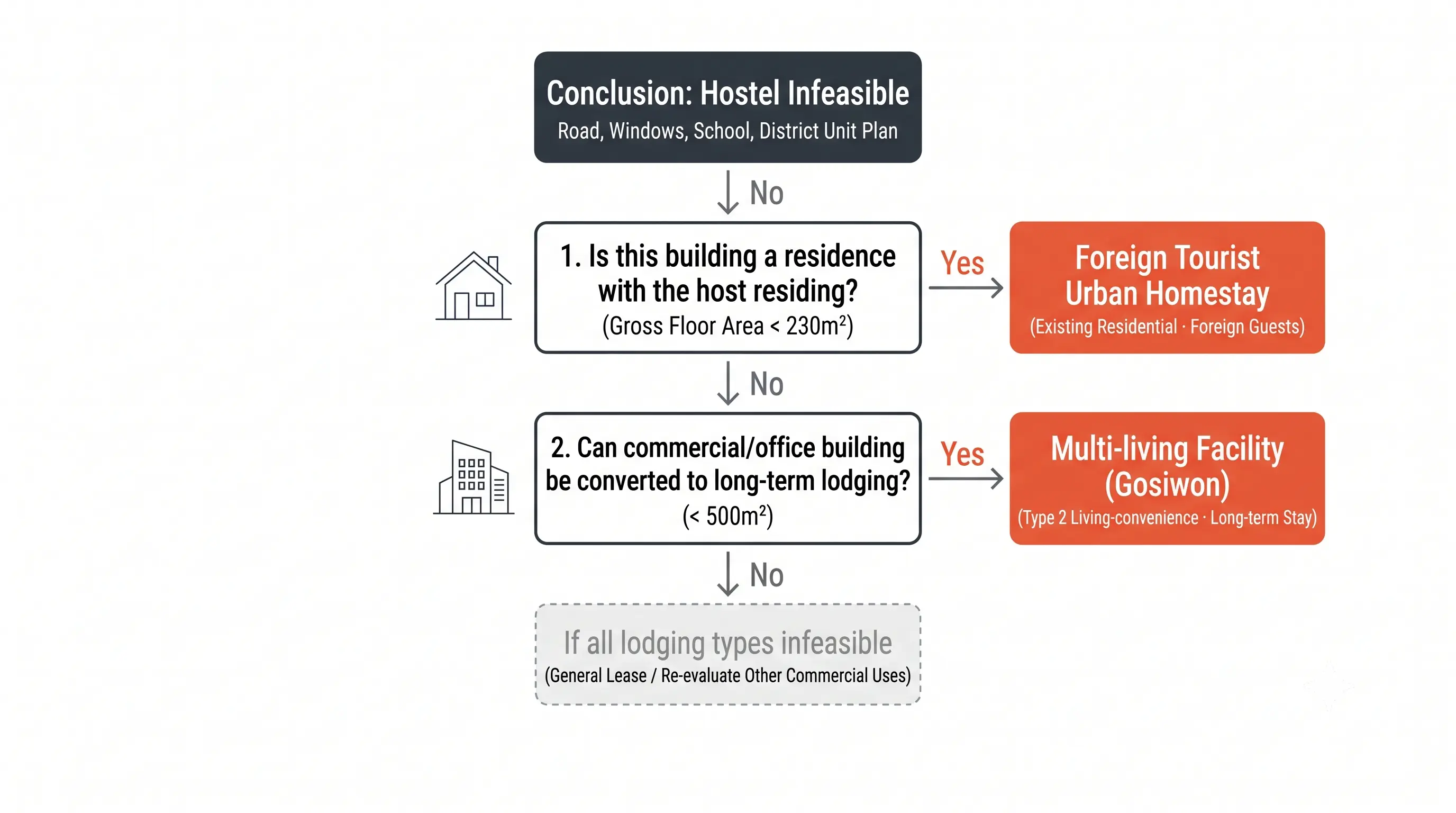
Test a building against the five preceding articles and a good many fail on the road, the windows or the school condition. That does not mean abandoning a lodging use altogether. Two alternatives come up repeatedly: multi-unit living facilities, known as gosiwon, and urban homestay for foreign tourists. The names sound similar, but the buildings they suit and the statutes behind them are entirely different, so the first job is working out which one your building fits.
The building type decides it first
The critical difference is that urban homestay is not a change of use at all — it is a business run from a dwelling. The operator actually lives in the house and lets part of it to foreign tourists, so it is never an option in a shop or office building. A gosiwon, by contrast, converts a neighbourhood facility building into long-stay accommodation, which makes it the alternative for commercial and office stock.
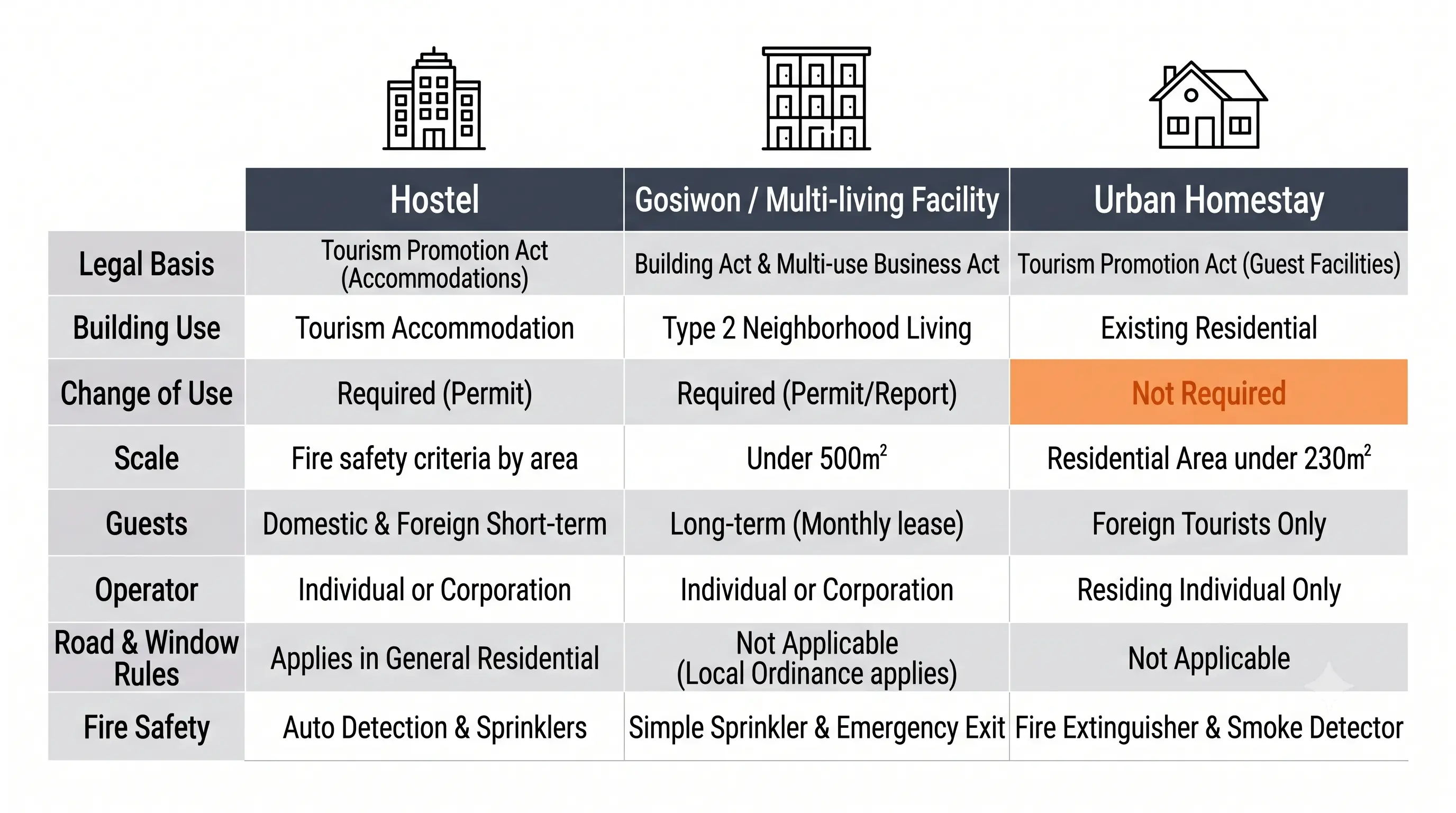
All three in one table
Hostels, gosiwon and urban homestay are all “rooms where several people stay”, but they start from different statutes. In particular, the road frontage and window setback rules that blocked the hostel are tourist-accommodation criteria under the Tourism Promotion Act, so they do not apply to gosiwon or urban homestay at all.
The economics differ too. A hostel is short-stay, so the nightly rate is higher but booking, cleaning and check-in carry a heavy operating load. A gosiwon is monthly long-stay: lower rates, simpler operation, steadier income. Urban homestay is closer to a homestay with the operator living in, which makes it hard to scale.
Gosiwon — the alternative for shop and office buildings
A gosiwon is a multi-unit living facility under the Building Act. Under 500㎡ total floor area it is a Class 2 neighbourhood facility; above that it is classified as lodging. To keep it as a neighbourhood facility, plan below 500㎡. Note that multi-unit living facilities sit in the business facility group, so converting from an office or a restaurant requires a change-of-use permit, exactly as a hostel would.
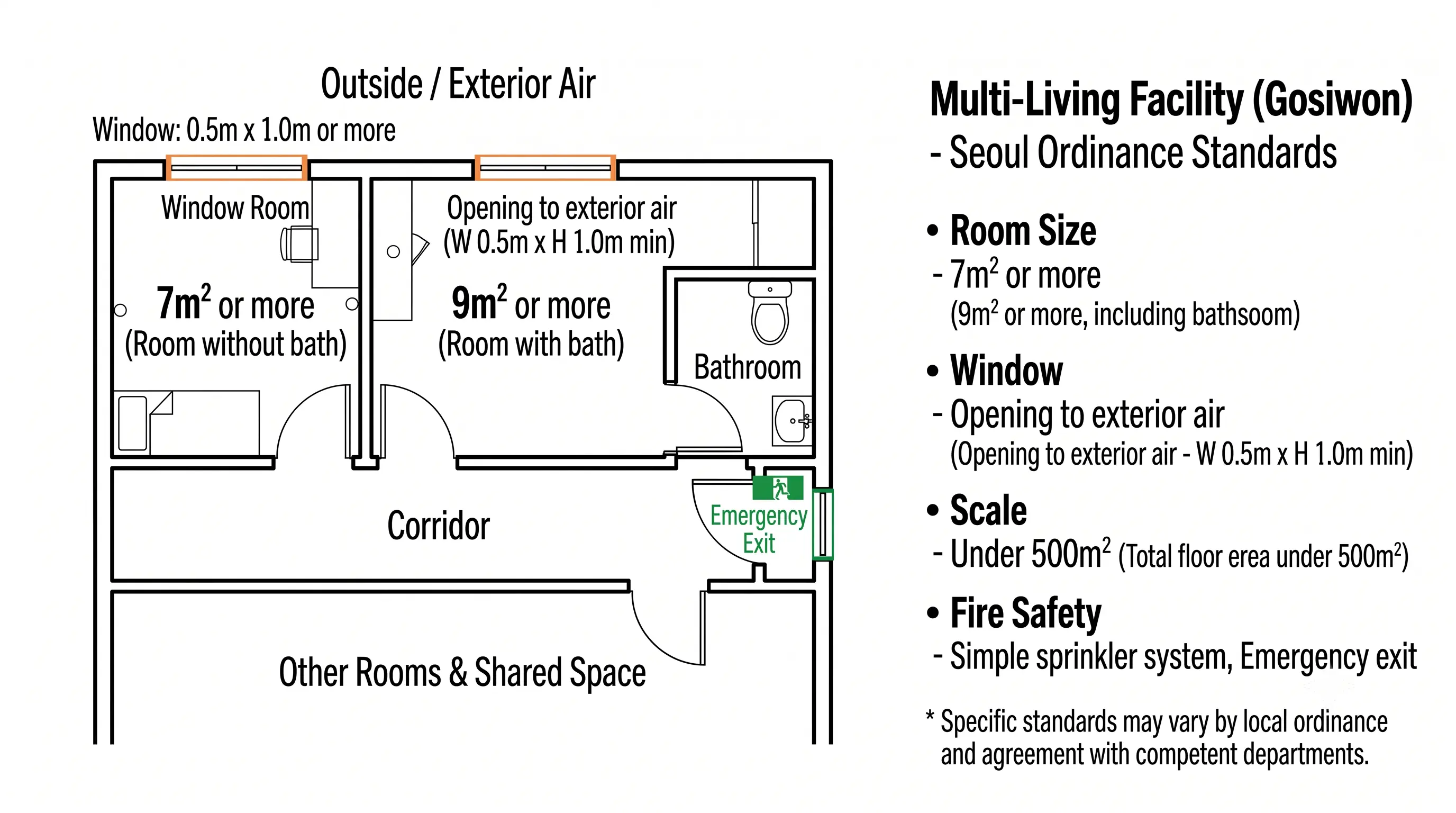
Standards were tightened considerably after the 2018 Gukil gosiwon fire. Since July 2022 the Seoul building ordinance has required a room area of at least 7㎡, or 9㎡ including a bathroom, and a window to open air at least 0.5m wide and 1.0m high. It applies to changes of use as well as new build. A gosiwon is also a multi-use establishment, so simplified sprinklers or better, plus emergency exits, are required.
Which is to say a gosiwon needs windows too. There is no distance-to-boundary rule as there is for a hostel, but every room needs a window to the outside, so deep, narrow buildings are hard to lay out. District unit plans sometimes prohibit multi-unit living facilities outright, and ordinances may restrict where they can go in residential zones, so check the site the same way you would for a hostel. Outside Seoul, check each local authority's own ordinance for the room standards.
Urban homestay — an option for people who live there
Urban homestay for foreign tourists is a tourist facility business under the Tourism Promotion Act. A resident of an urban area uses the home they live in to provide lodging and meals so that foreign tourists can experience Korean family life. The building use stays as a dwelling; you simply register with the district tourism office.
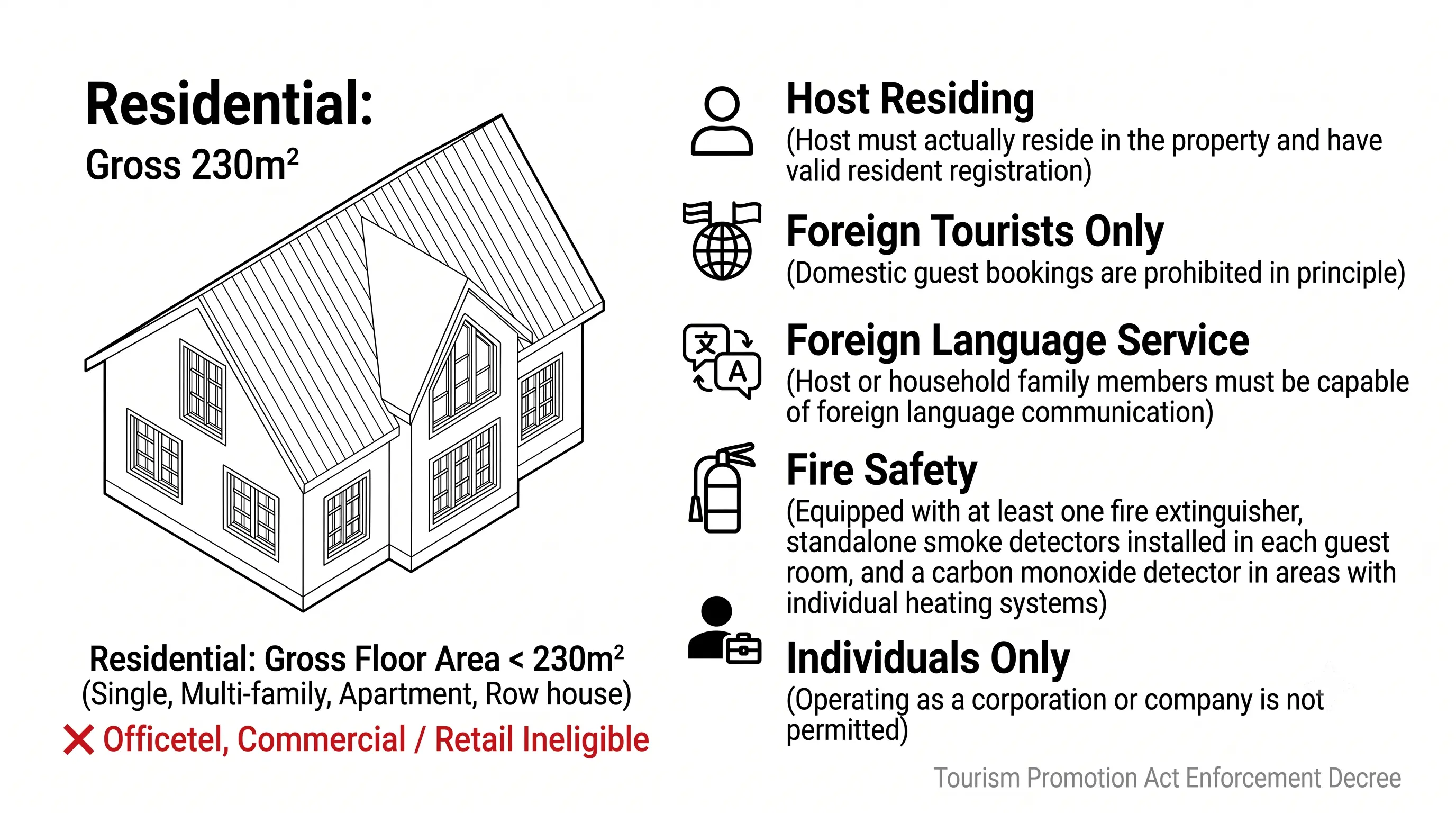
The requirements are simple: a dwelling under 230㎡, the operator in actual residence, and the ability to assist in a foreign language. On fire, at least one extinguisher, a standalone alarm detector in each guest room, and a carbon monoxide alarm where heating is individual. In exchange, guests must in principle be foreign tourists only, corporations cannot operate one, and living space inside an officetel or a neighbourhood facility does not qualify.
Beyond the statutory requirements, knowing the criteria applied in practice saves wasted trips. For apartments, row houses and multi-family housing, registration usually requires consent from residents — typically more than half of all households, and always the immediately adjoining unit — plus the management office's consent. Basement and semi-basement units and studio-type urban housing are generally excluded, and a separate cooking facility inside a guest room is not permitted. Only one unit, on the floor where the operator actually lives, can be registered at a time.
If you rent the home you intend to operate from, the usual approach is to state in the lease that the property will be used for urban homestay and to file the landlord's written consent alongside. Detailed criteria vary slightly between district offices, so check with the competent tourism office before applying.
For older houses, some district offices ask for structural safety documents. What is required differs from office to office, so rather than commissioning a costly detailed structural assessment first, find out what your district office actually wants.
Closing the series
A hostel conversion is, in the end, a matter of passing through four layers in sequence: the land (zoning, schools, roads), the walls (windows, fire-resistant glazing), the rooms (fire and escape) and the paperwork (business plan, registration). If any one of them blocks you, changing direction before spending money is the better course, and that is where a gosiwon or urban homestay becomes a realistic second option. Either way, the preliminary review comes before the lease and the fit-out.
Related forms
Statutory forms published on the Korean Law Information Center, in Korean. A gosiwon proceeds through building permitting, so it is lodged on Seumteo rather than with a separate form.
- Tourism business registration applicationTourism Promotion Act Enforcement Rule, Form 1 · also used to register urban homestay HWP ↓
Sources: Building Act Enforcement Decree Table 1 (multi-unit living facilities) and Article 14 (facility groups); Seoul Metropolitan Government Building Ordinance Article 3-2 (building standards for multi-unit living facilities); Special Act on Safety Control of Multi-Use Establishments; Tourism Promotion Act Enforcement Decree Article 2 and Table 1 (urban homestay for foreign tourists). Detailed criteria may differ under each local authority's ordinance and registration guidance.
Frequently Asked Questions
Q. Can I run an urban homestay in a commercial building?
No. Urban homestay can only be registered in a dwelling under 230㎡ where the operator actually lives.
Q. Do the road and window rules apply to a gosiwon?
The hostel road and window setback rules do not apply. Instead, the ordinance room area and window standards and the multi-use establishment fire standards apply.
Q. Does converting an office into a gosiwon need a permit?
Usually yes. A multi-unit living facility sits in the business facility group, above an office.
Q. Can an urban homestay operate in an apartment?
Yes. In practice it needs resident consent (typically a majority of households including the adjoining unit) and the management office's consent, and only the unit actually lived in can be registered.
Q. Which of the three suits my building?
That depends on the building type, area and location together. Send us the lot number and the building register and we will compare all three. Ask for a preliminary review →