
Regulation Guide · 2026. 09
Hostel Conversion —
Conditions and Procedure at a Glance
LEA Architects · Junsu Kim, Architect
Enquiries about turning vacant shops and offices into hostels have risen sharply. But a hostel is one of the harder changes of use: the Building Act applies, and the Tourism Promotion Act is layered on top of it. Here is what you need to know before signing anything, set out in six drawings.
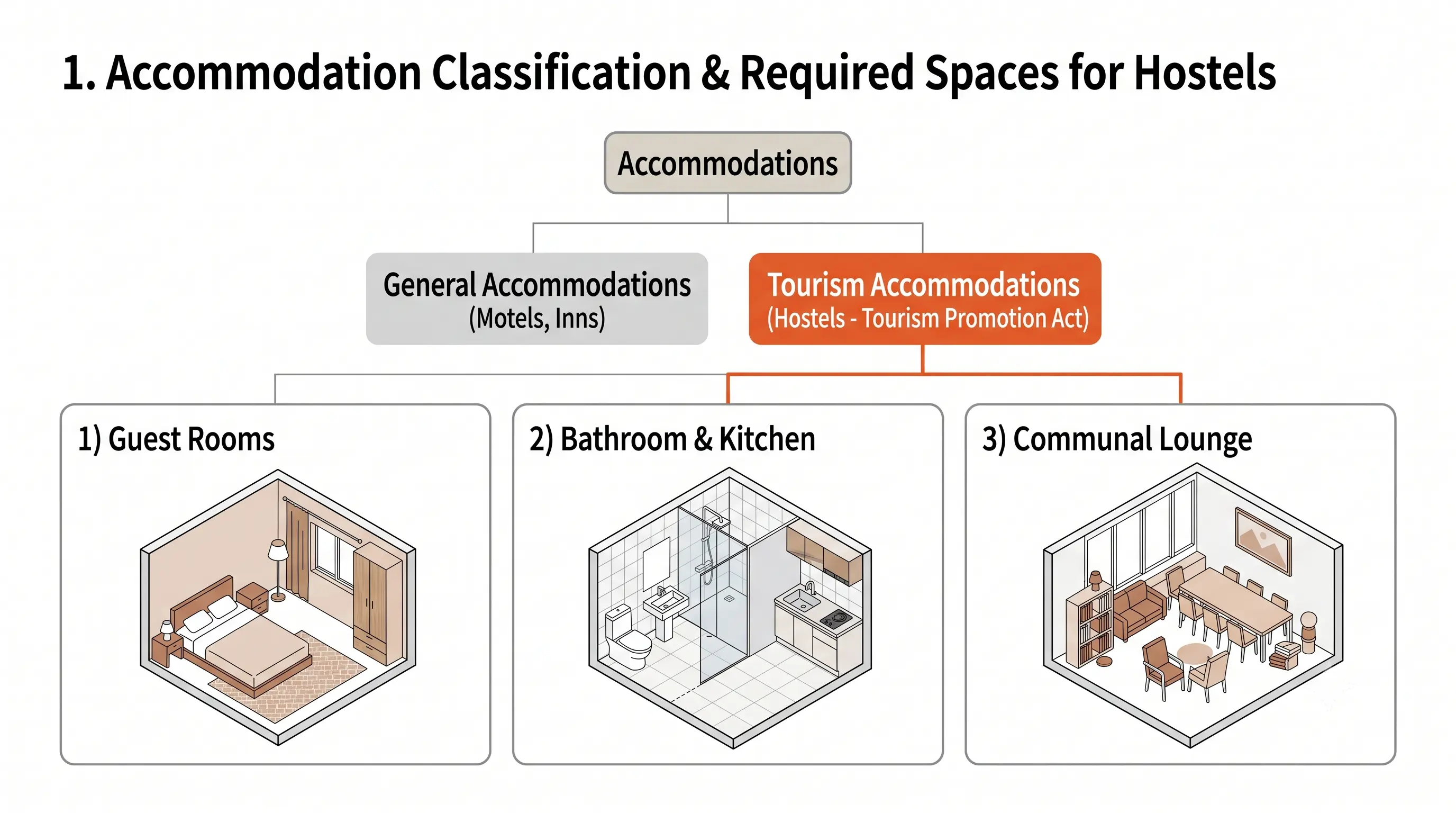
A hostel is not the same use as a motel
Both are lodging, but a hostel sits in the same group as a tourist hotel — tourist accommodation. That means it must meet the registration standards of the Tourism Promotion Act, and a floor plan that is nothing but guest rooms will not register.
Permit, or notification?
The Building Act sorts uses into nine facility groups. Moving up the ladder requires a permit; moving down requires only a notification. A hostel belongs to the business facility group, so converting from an office, a restaurant or a dwelling requires a permit. Converting from a gosiwon, which sits in the same group, is handled as an amendment to the building register.
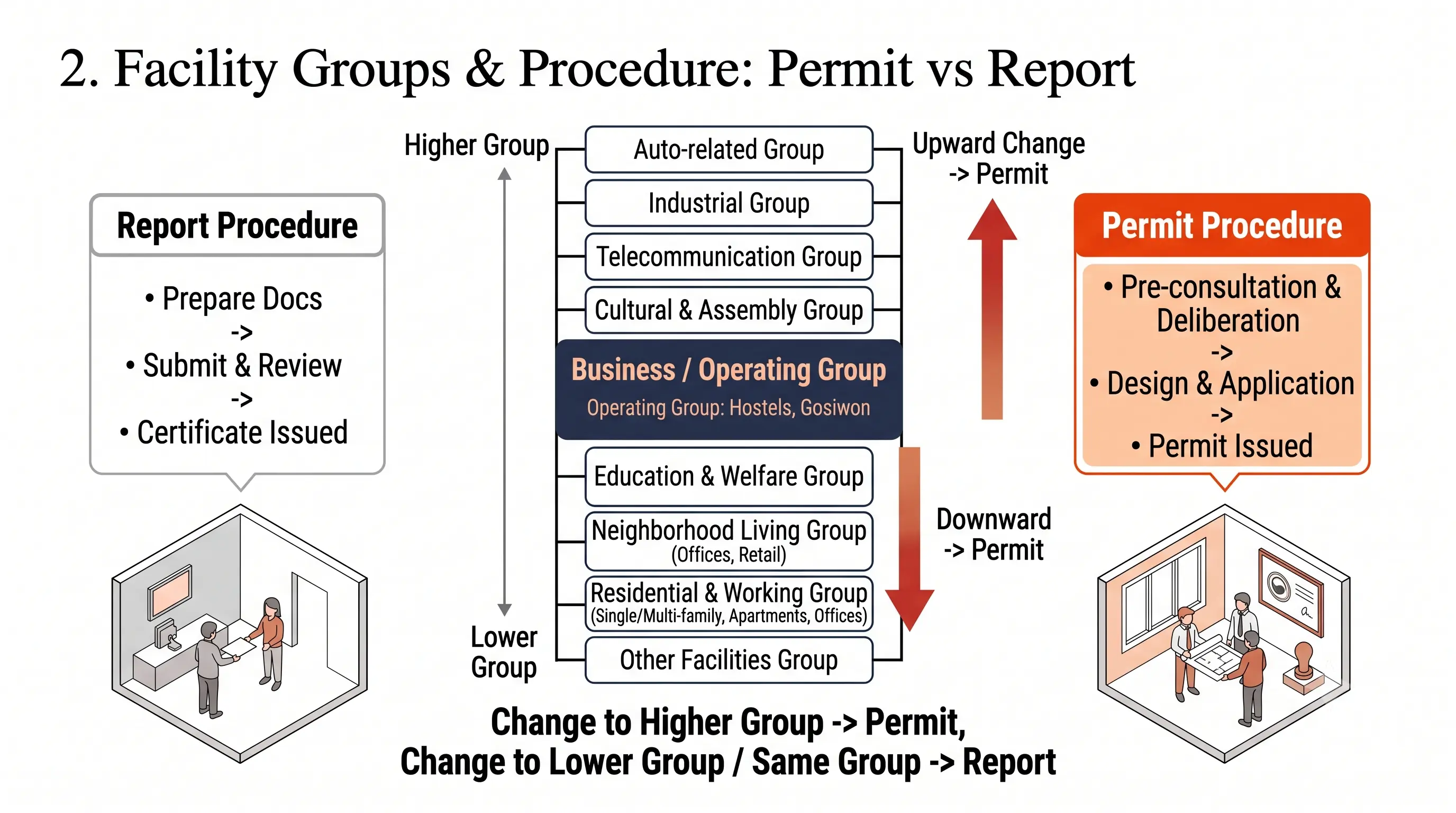
Note that “office” itself is classified by area. Within one building, offices totalling under 30㎡ are Class 1 neighbourhood facilities, under 500㎡ are Class 2, and anything larger is a business facility. Start by checking the building register.
Two departments, three applications
A change-of-use permit from the building department is not the end of it. You also need tourism business plan approval from the tourism department, and after construction you must complete tourism business registration before you can trade.
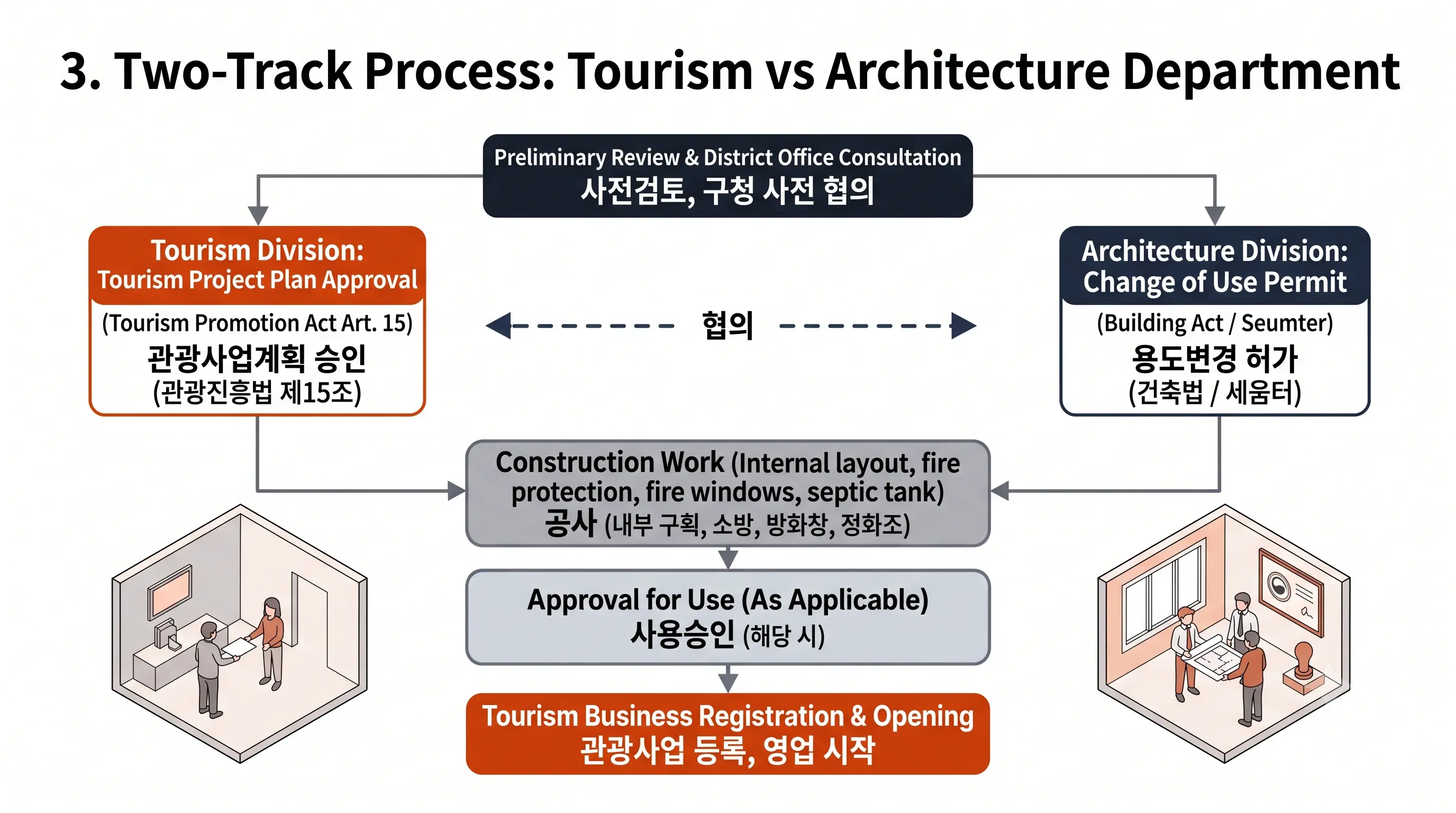
Some district offices take the business plan approval and the change of use in sequence; others take them in parallel. When you appoint an architect, confirm explicitly whether business plan approval is inside their scope of work. Some firms handle only the change of use and leave the approval to the owner.
Will your building qualify?
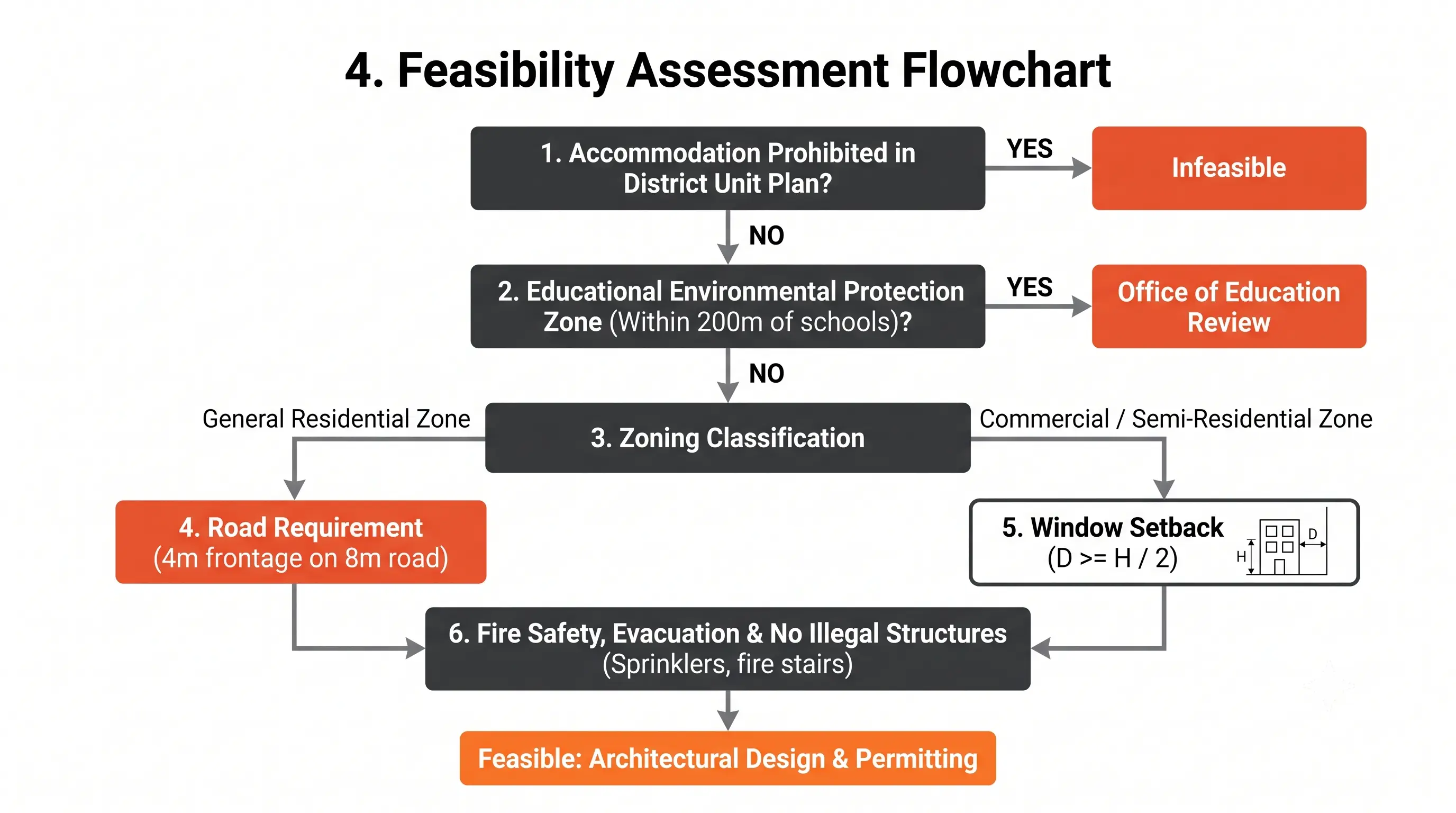
Before working through the regulations one by one, there is an order in which to rule things out. Stop at the first item that blocks you. Zoning and district unit plans can be checked by lot number on Toji-eum, or on the Seoul Urban Planning Portal for Seoul addresses.
In a general residential zone — roads and windows
General residential zones are not normally open to lodging at all. Tourism business plan approval makes it possible as an exception, but in exchange the project must clear the residential-amenity criteria of Enforcement Decree Article 13. There are two. The site must adjoin a road at least 8m wide for a length of at least 4m; and any wall with windows facing a neighbouring lot must stand back from the boundary by at least half the building height.
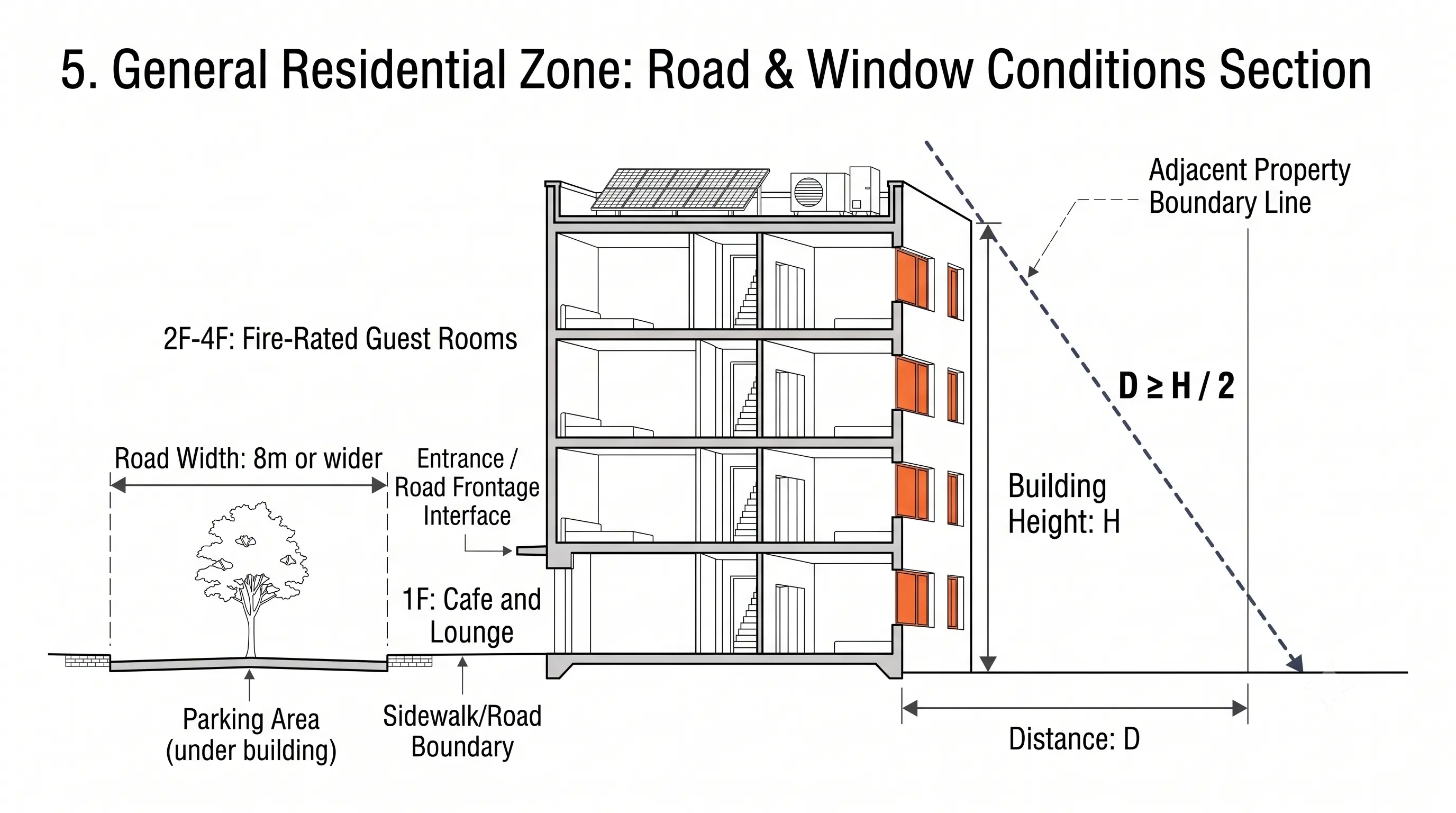
Few buildings in central Seoul can achieve that distance. Most projects therefore solve it by screening — blocking the windows on the affected face — because the criterion attaches to “a wall with windows”. The road requirement relaxes to 4m in areas the district office has specifically designated, provided the hostel operates 20 rooms or fewer.
One warning. The Ministry of Government Legislation has interpreted the height criterion as applying not merely to the floors used as a hostel but to the entire building the hostel occupies. Convert only the third floor and the windows of a ground-floor shop on the same face may still fall within scope. This is frequently what stops projects in multi-owner buildings where each unit has a different owner.
What the building itself has to carry
Once the site passes, attention turns to the building. Most of these items translate directly into cost, so it is worth checking them together before design begins.
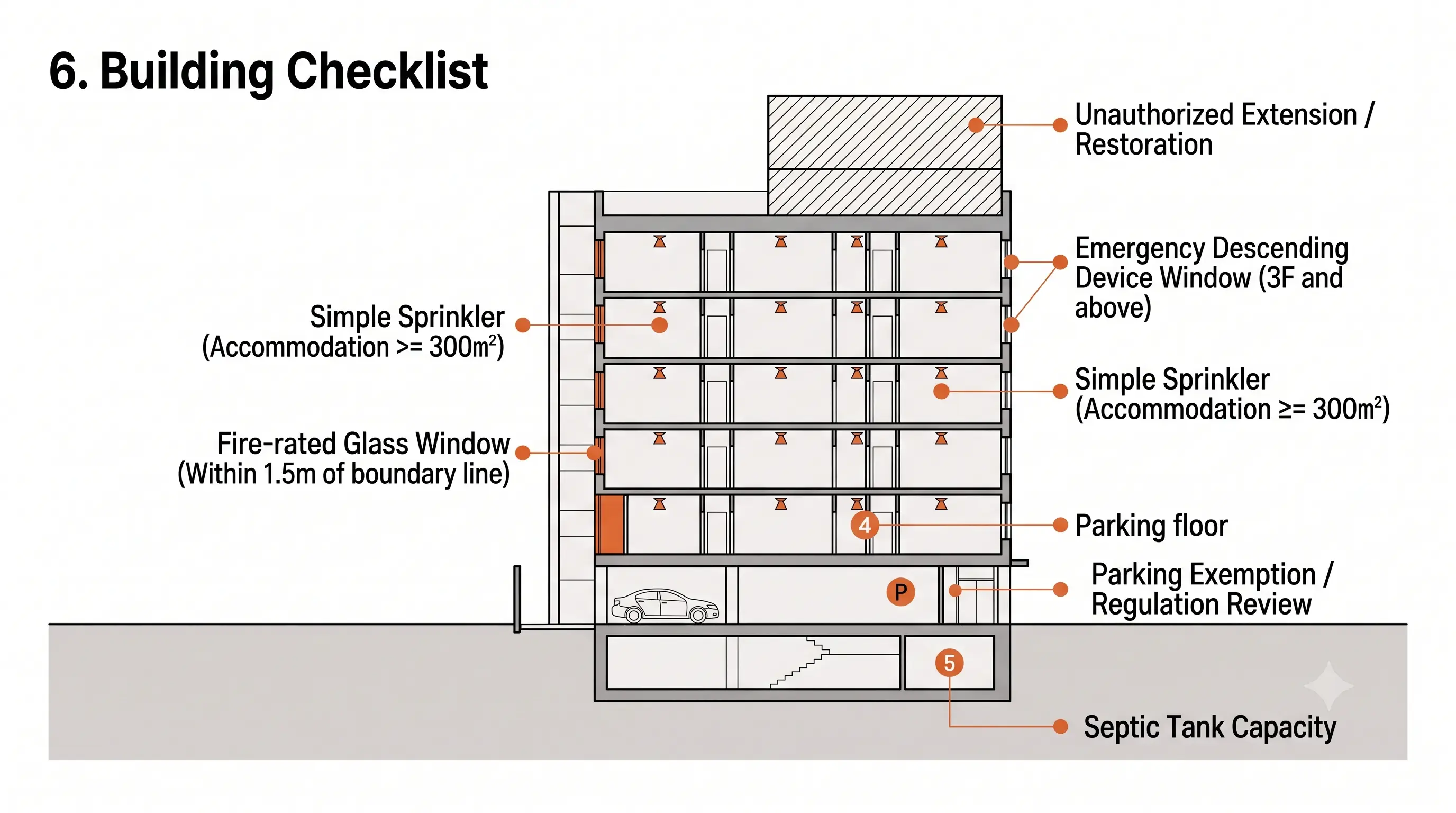
The 300㎡ threshold in the fire standards counts not only guest rooms but shared areas such as stairs and corridors. Floors at third level and above need an escape window — yet in a general residential zone you may be required to block windows, so the two standards collide. The tourism department and the fire service apply different rules. The usual fixes are to place guest rooms on the road side or to reduce the room count.
If the converted area reaches 500㎡ or the work involves major repair, you will also need completion approval, and depending on scale an obligation to install accessibility features may arise. Where unauthorised extensions remain on the building, the change-of-use application will not even be accepted — so budget for the cost and time of reinstatement.
Checklist before you sign
Sources: Building Act Article 19 and Enforcement Decree Article 14; Building Act Enforcement Decree Table 1; Tourism Promotion Act Articles 15 and 16; Tourism Promotion Act Enforcement Decree Article 13; Ministry of Government Legislation statutory interpretation (Tourism Promotion Act Enforcement Decree Article 13(1)3(b)); Act on Installation and Management of Fire-Fighting Systems Enforcement Decree Table 4; Parking Lot Act Enforcement Decree Article 6. Whether a particular building qualifies depends on consultation with the competent local authority and on site inspection.
Frequently Asked Questions
Q. Do I need a permit to convert an office into a hostel?
Yes. A hostel sits in the business facility group, above an office or a business facility, so a change-of-use permit is required. Tourism business plan approval must also be obtained separately.
Q. Can a hostel operate in a general residential zone?
Yes, with tourism business plan approval. But both the road frontage condition and the window setback condition must be satisfied.
Q. If only one floor becomes a hostel, must windows on other floors be blocked too?
They may have to be. The height and setback criteria apply to the whole building in which the hostel is located.
Q. How do I find out whether my building qualifies?
With a lot number and the building register we can review the site conditions first. Checking before any interior work begins is by far the cheapest point to do it. Ask for a preliminary review →