
Regulation Guide · 2026. 09
Is Your Building Eligible for a Hostel? —
Zoning, Schools and Roads
LEA Architects · Junsu Kim, Architect
The first question in any hostel consultation is “will my building work?” The answer is decided by the land before the building. Zoning, the district unit plan, distance from schools, and the road. No amount of good design changes these four, so if you are blocked here the review ends on the spot. This article sets out how to check each of them yourself.
One document rules out half of it
Search a lot number on Toji-eum (eum.go.kr) and you can view the land use planning certificate free of charge. Three of the things a hostel site review needs are on that single sheet: the zoning, whether the lot falls inside a district unit planning zone, and whether it falls inside an educational environment protection zone.
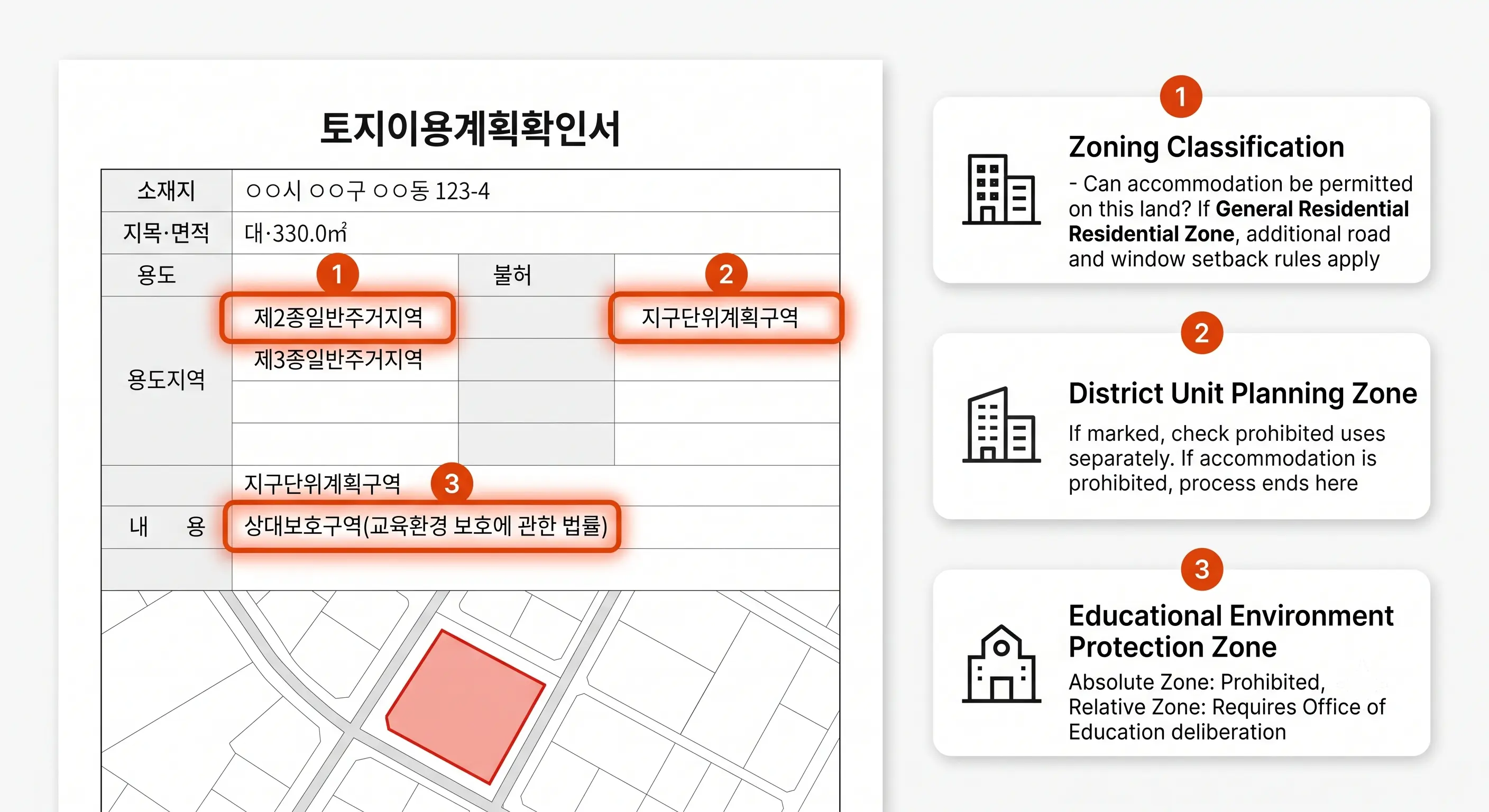
Zoning and district unit planning zones appear in the field for areas and districts under the National Land Planning and Utilisation Act; educational environment protection zones appear in the field for areas designated under other statutes. The latter also states whether the lot is in an absolute or a relative protection zone, so read that at the same time.
Zoning — is lodging allowed on this land at all?
Lodging is normally difficult outside a commercial zone. However, Article 16 of the Tourism Promotion Act provides that the use restrictions of the National Land Planning Act do not apply to tourist accommodation which has received tourism business plan approval. That exemption is precisely why a hostel can sit in a residential zone. In exchange, the exemption covers only certain zones, and each zone carries different conditions.
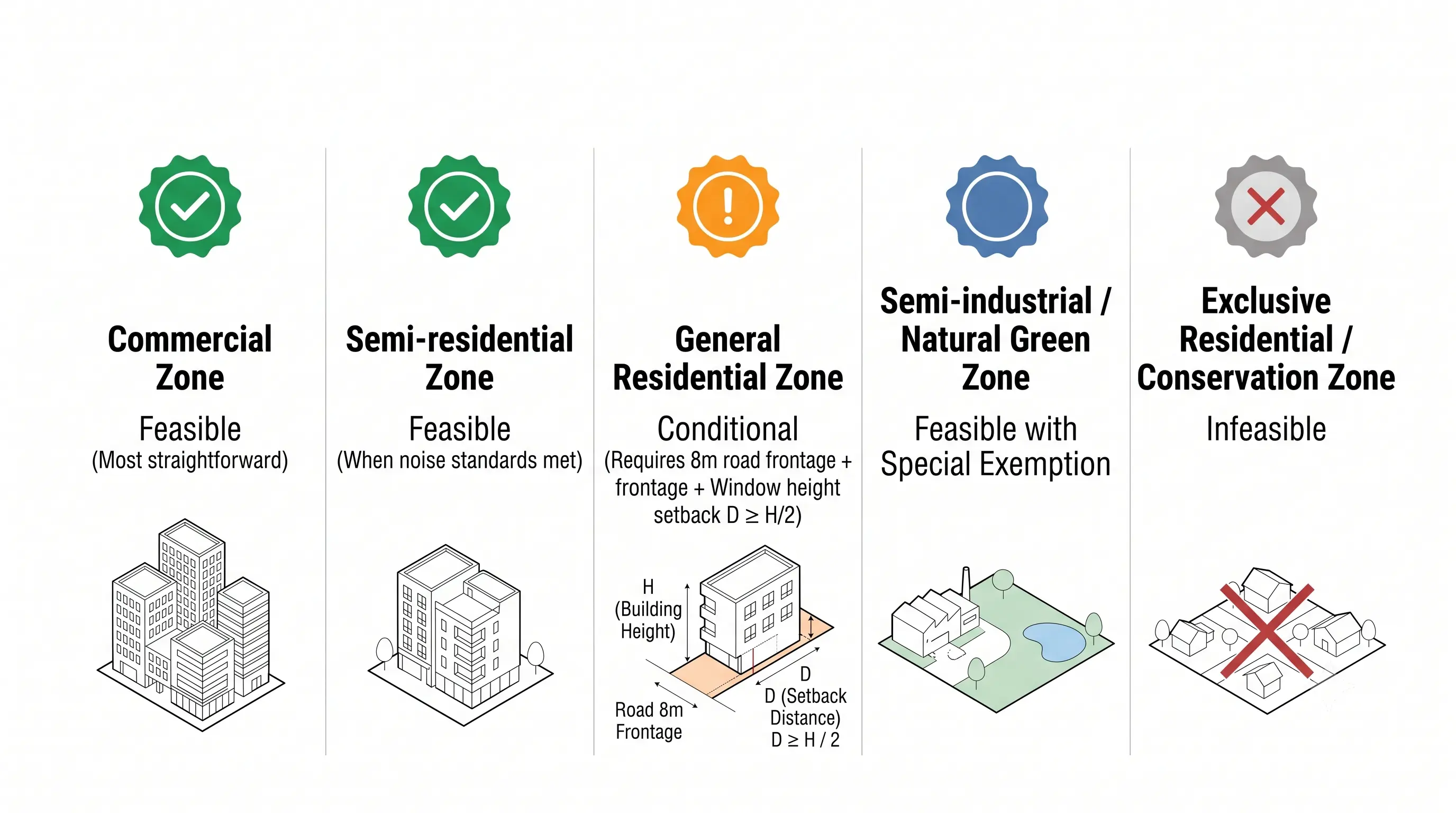
Commercial zones are the most straightforward. Semi-residential zones add one condition: noise-generating facilities must be placed in the basement or otherwise arranged so as not to harm the surrounding residential environment. General residential zones are possible, but only after clearing both the road frontage and the window setback conditions — and this is where most real consultations stall. Semi-industrial and natural green zones also fall within the exemption.
Conversely, zones outside the exemption — exclusive residential, production green and conservation green — are effectively not candidates. The Ministry of Government Legislation has also held that where a site straddles natural green and conservation green land, the exemption cannot be stretched to cover the conservation green portion. A site spanning two zones must be assessed zone by zone.
District unit plan — is lodging on the prohibited list?
Even after the zoning passes, a lot inside a district unit planning zone is filtered once more. District unit plans set permitted and prohibited uses block by block, and if lodging is on the prohibited list it is impossible regardless of zoning. Busy districts and areas around stations are frequently inside such zones, so this is not an item to skip.
In Seoul, searching a lot number on the Seoul Urban Planning Portal shows the permitted and prohibited uses for that parcel directly. Elsewhere, open the district unit plan drawing and implementation guidelines on Toji-eum and read the building use section, or give the lot number to the urban planning division of the district office and ask. Amending a district unit plan is not something an individual owner can realistically pursue, so if lodging is prohibited, changing direction here is the practical choice.
Near a school — educational environment protection zones
In law a hostel is a form of hotel business. The Educational Environment Protection Act lists lodging and hotel businesses as prohibited facilities within an educational environment protection zone, so a building near a school faces the same restriction. The zone comes in two layers.
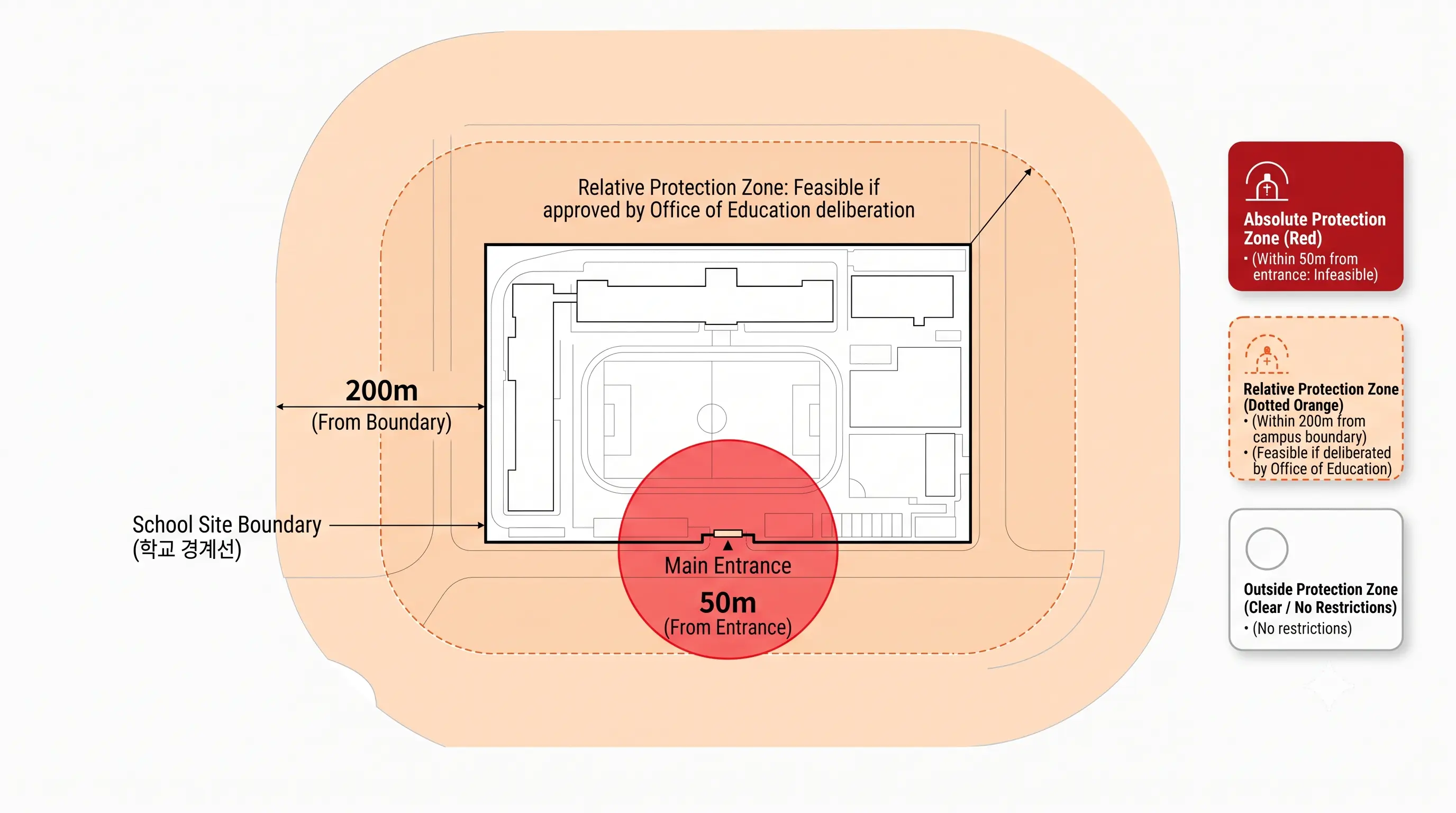
In the absolute protection zone (within 50m in a straight line from a school gate) a hostel is not possible. In the relative protection zone (within 200m of the school boundary, excluding the absolute zone) it is possible if the educational environment protection committee of the competent district education office reviews the proposal and accepts that it will not adversely affect the learning environment. That written determination is an attachment to the tourism business plan approval application, so it is safer to obtain it before signing a lease or an architectural contract.
One caution. Older posts still circulating online state that no review is needed beyond 75m from a school gate. That was a temporary exemption under the Tourism Promotion Act and it expired on 22 March 2021. It no longer applies.
In a general residential zone — the road condition
In a general residential zone, Tourism Promotion Act Enforcement Decree Article 13 requires that the site adjoin a road at least 8m wide for a length of at least 4m. The statutory wording is that it must abut the road “so as to permit the passage of people or vehicles”. Commercial and semi-residential zones have no such requirement.
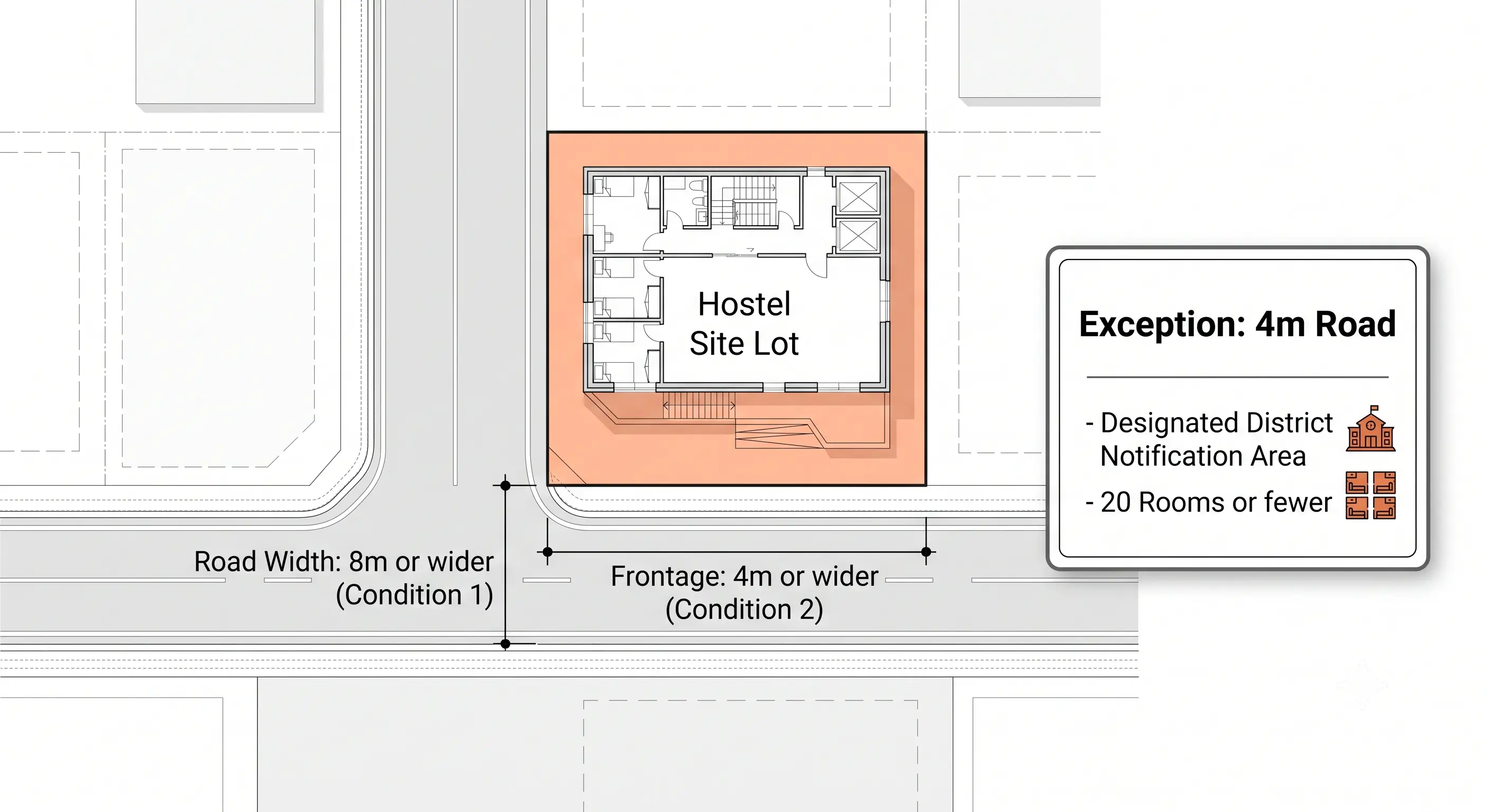
There is one exception. In areas the district mayor has separately designated and published, having regard to visitor numbers and distance from a special tourist zone, a hostel operating 20 rooms or fewer may use a 4m road. Only some districts have issued such a notice, so check with the tourism division of the competent office. Local authorities may equally tighten the standard by ordinance.
The road width you see on site and the width on the cadastral map can differ, depending on whether a footway is included and whether the building line has been set back. Confirm it against the cadastral map and the road register. If you have cleared all of this, the building conditions come next. The other gate in a general residential zone — window setback — is covered in detail with drawings in the next article.
Sources: Tourism Promotion Act Article 16(5) and Enforcement Decree Articles 13 and 14; Educational Environment Protection Act Articles 8 and 9; Ministry of Government Legislation statutory interpretation (Tourism Promotion Act Article 16(5), site straddling natural green and conservation green zones). District unit plans and road relaxation notices vary by local authority, so confirmation with the competent district office is required.
Frequently Asked Questions
Q. Which zones can a hostel go into?
Commercial zones are the most straightforward. With tourism business plan approval, general residential, semi-residential, semi-industrial and natural green zones are also possible. General residential zones add road and window conditions. Zones outside the exemption, such as exclusive residential, are effectively not viable.
Q. Can a building near a school become a hostel?
Not within 50m of a school gate (the absolute protection zone). Within 200m of the school boundary (the relative protection zone) it is possible if the district education office review is passed.
Q. What if the road in front is only 4m wide?
In a general residential zone that is difficult in principle. A 4m road is accepted only where the district office has designated the area and the hostel has 20 rooms or fewer. Commercial and semi-residential zones have no such requirement.
Q. What if I cannot work this out myself?
Send us the lot number and we will review the zoning, district unit plan, educational environment protection zone and road conditions first. Ask for a preliminary review →