
Regulation Guide · 2026. 10
Balcony Expansion Permit —
What Sellers Should Settle Before Listing
LEA Architects · Junsu Kim, Architect
In Short
- However long ago the extension was done, a buyer who learns of it after signing can turn it into a demand on price or cost.
- Settling the action permit before the sale narrows the argument — but until the completion inspection is passed, say plainly that the procedure is not finished.
- Whichever route you take, put the responsible party, the cost, the deadline and the inspection question in the contract.
Why It Lands on the Seller
Many owners have lived with an extended balcony for years before deciding to sell. It may have raised no questions when the work was done, but buyers now search it up themselves, or ask an AI, and check the permit status first. Fit-out contractors and management offices asking for the permit document have become more common too.
The buyer grows uneasy, and that unease turns into demands on price, on cost sharing, on the schedule. If the market moves while the deal drags on, the same point gets used to unsettle the contract itself. It weighs on the agent as well — so a sale runs far more smoothly when the seller has dealt with it first.
First, the Two Stages
Expanding a balcony in multi-family housing requires an action permit under the Multi-Family Housing Management Act (Article 35; Enforcement Decree, Table 3), and the procedure runs in two stages: the action permit, which approves "this is what we will do" before the work, and the completion inspection, which confirms "this is what we did" afterwards. The column for agents and the one for buyers set this out in more detail.
Two points deserve a seller's attention. First, regularising an existing extension is usually not a retroactive approval of the old work but the same procedure as a fresh extension. Second, in our experience the action permit alone does not reach the building register — only the completion inspection puts it there. Practice varies between district offices, so confirm with the one with jurisdiction.
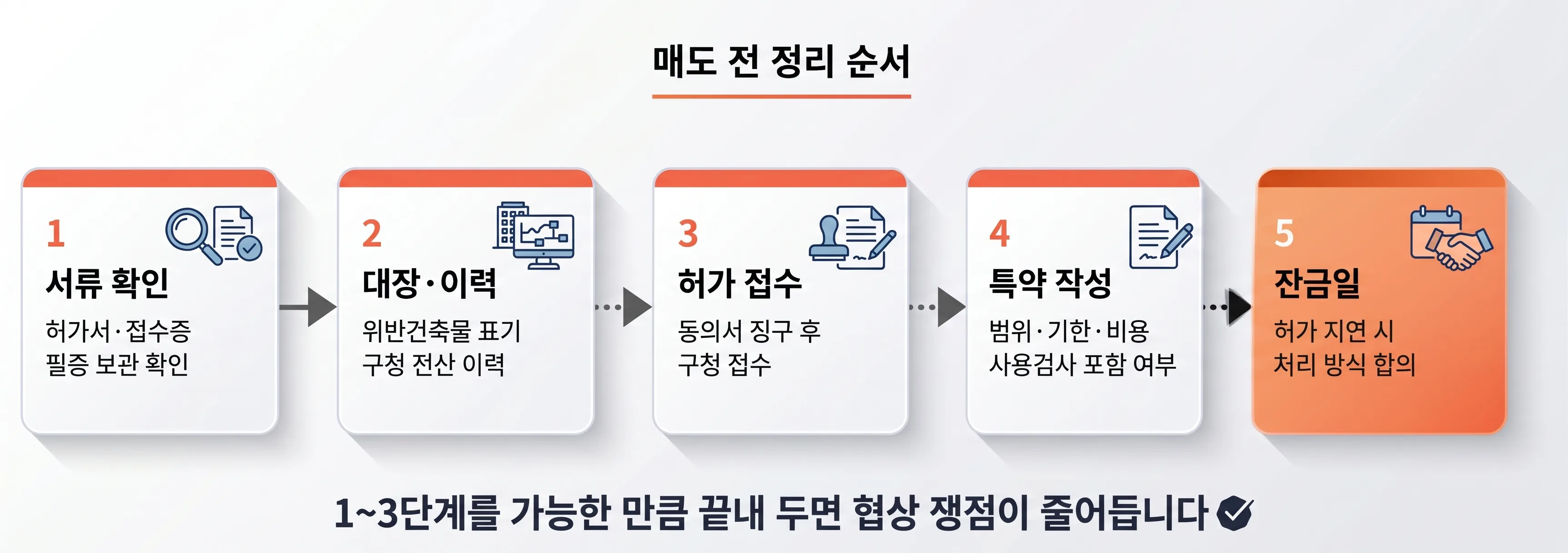
What to Check Before Listing
| Item | How |
|---|---|
| Old permit papers | Look for the action permit, the filing receipt or the completion certificate. Sometimes a previous owner obtained them. |
| District office records | A permit may exist without showing on the register. Check for a record with the district office before filing again, so you do not file twice. |
| Building register | Check Gov24 or Seumteo for an unauthorised-structure flag. |
| Management office policy | Find out in advance whether the complex asks for the permit document when the buyer does interior work after moving in. |
Three Routes
No statute says who must do what; it is for the parties to agree. From the seller's side, decide which of these three you are taking before you enter the deal.
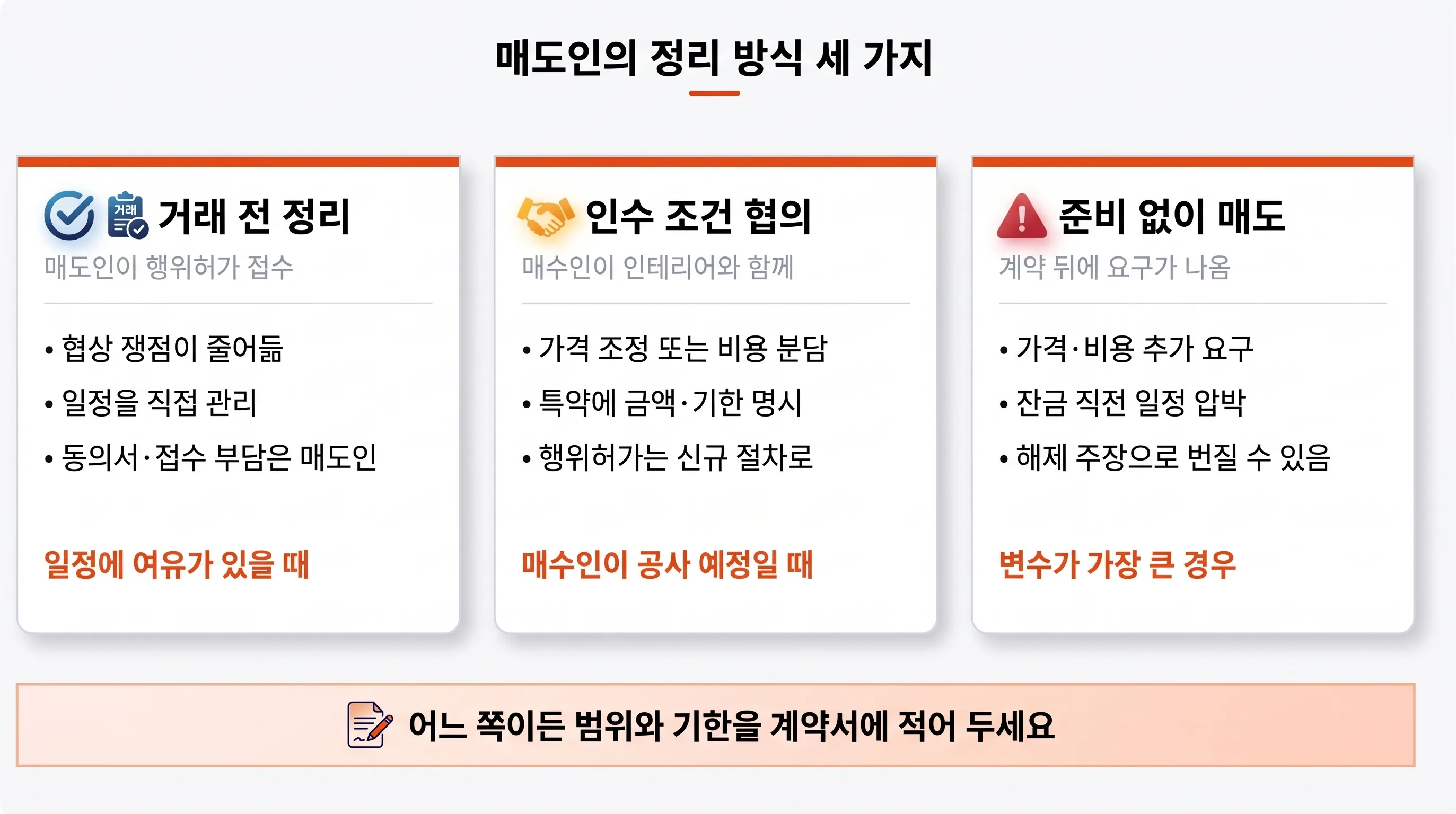
| Route | Upside | Watch for |
|---|---|---|
| A. File before the sale | Fewer points to argue, and you control the schedule yourself. | Collecting resident consent and filing fall to you. Work back from the balance payment date when you file. |
| B. Agree it as a condition of transfer | If the buyer is replacing windows and insulation anyway, let them handle it with that work and reflect it in the price. | Put the adjusted amount and who is responsible clearly in the special clauses, or further demands follow. |
| C. Sell without preparing | No cost up front. | If a demand comes after signing, there is little time to respond. It often turns into schedule pressure just before closing. |
If you take route A, allow two weeks to a month once the documents are in order, and remember that resident consent is a separate requirement (half or more is the benchmark, though this varies by complex and by jurisdiction).
Why "We Have the Permit, So It's Lawful" Is the Wrong Thing to Say
Holding the action permit is reassuring, but until the completion inspection is passed the procedure is not finished. Describe the unit as simply "permitted" without that distinction and the dispute only grows when the buyer later asks for the inspection, or for it to appear on the register.
If the inspection is demanded, performance documents and a site check for fire-rated panels, glass and doors widen both the scope and the cost. In that case it is more realistic to agree separately who carries the inspection and at what cost, or to settle it through the price instead. Saying from the outset "the action permit is ours, the completion inspection is to be agreed separately" takes most of the argument out of this stage.
Clauses from the Seller's Side
Adapt the wording to the case, and have a legal professional review it where that matters.
The scope in ④, and the bar on further claims, matter most. Leave that blank and you can be asked again for the inspection or the construction cost, even after agreeing the permit.
Before You List
- Have you looked for an old permit, filing receipt or certificate?
- Have you checked whether the district office holds a record?
- Have you chosen a route (A, B or C) and told your agent?
- Are you ready to state plainly that the completion inspection has not been done?
- Does a filing date work back cleanly from the balance payment date?
What an Architect Can and Cannot Take On
Our scope is the as-built drawings, preparing the action permit application and filing it. The completion inspection turns on construction records and the state of the unit, so there we can only walk you through the procedure. Resident consent you prepare separately, and the price or responsibility talks with the buyer are for the parties and the agent to settle. Come to us with the negotiation resolved and the scope clearly stated, and it is far easier to hold a schedule.
Frequently Asked Questions
Q. Can I sell a unit with an extended balcony and no action permit?
The sale itself is not prohibited, but buyers often raise the permit after signing and ask for a price adjustment or a share of the cost. Disclose the condition truthfully before the contract, and fix responsibility, cost and deadline in a special clause.
Q. What does the seller gain by obtaining the permit first?
Fewer points to negotiate, and control of the schedule. But the action permit approves the planned work and the procedure ends with the completion inspection, so tell the buyer plainly how far it has been taken.
Q. I think a permit was obtained years ago, but nothing shows on the register.
In our experience the permit alone does not reach the register; only the completion inspection puts it there. A record may still sit in the district office system, so check with them before filing again. Practice varies between offices.
Q. How long does it take, and can it meet the balance payment date?
Once the documents are in order, typically two weeks to a month. Resident consent is separate, and the ratio varies by complex and by jurisdiction. Work the filing date back from closing, and write into the clauses what happens if the permit runs late. Send us the building and unit number with the current condition and we will give you a timeline. Request a pre-review →
Sources: Multi-Family Housing Management Act Article 35 and Table 3 of its Enforcement Decree; the December 2005 legalisation of balcony structural alteration; the Housing Act Enforcement Decree amendment notice easing consent requirements for balcony expansion (Ministry of Land, Transport and Maritime Affairs); Michuhol-gu Office, "Building Administration Explained" (balcony expansion in multi-family housing: action permit and completion inspection). This article is general information, not legal advice, and practice varies between district offices and between complexes. Confirm the specifics with the district office with jurisdiction and with a professional.