
Regulation Guide · 2026. 10
Balcony Expansion Permit —
What Buyers Should Check Before Signing
LEA Architects · Junsu Kim, Architect
In Short
- Buying an extended unit is not a problem in itself, but the burden of regularising it can pass to you.
- Before signing, confirm on paper whether an action permit was granted and whether the completion inspection was passed. A verbal assurance becomes an argument later.
- Writing who settles it, by when, and at whose cost into a special clause heads off most disputes.
Why Finding Out Afterwards Is Too Late
Apartments with the balcony opened up into the living room or a bedroom are common. Whether that work ever went through an action permit, though, is invisible on a viewing. Most buyers find out once they start their interior work after moving in.
A growing number of complexes have the fit-out contractor ask about the permit when quoting, or the management office demand the permit document as a condition of approving the work and the elevator protection. Without it the work stops, and from that point the schedule and the cost are the buyer's problem. Where the extension is registered as an unauthorised structure, the owner can face a correction order, and depending on the lender's criteria it can surface in a loan or guarantee review.
Which is why this belongs before the contract, not after the balance payment.
First, the Two Stages
Expanding a balcony in multi-family housing requires an action permit under the Multi-Family Housing Management Act (Article 35; Enforcement Decree, Table 3), and the procedure runs in two stages: the action permit, which approves "this is what we will do" before the work, and the completion inspection, which confirms "this is what we did" afterwards. The column written for agents sets this out in more detail.
In the field, many owners take the permit and never return for the inspection. And in our experience the permit alone does not reach the building register — only the completion inspection puts it there. Practice varies between district offices, so confirm with the one with jurisdiction. A clean register, in other words, does not tell you the extension was ever regularised.
What to Check, in Order
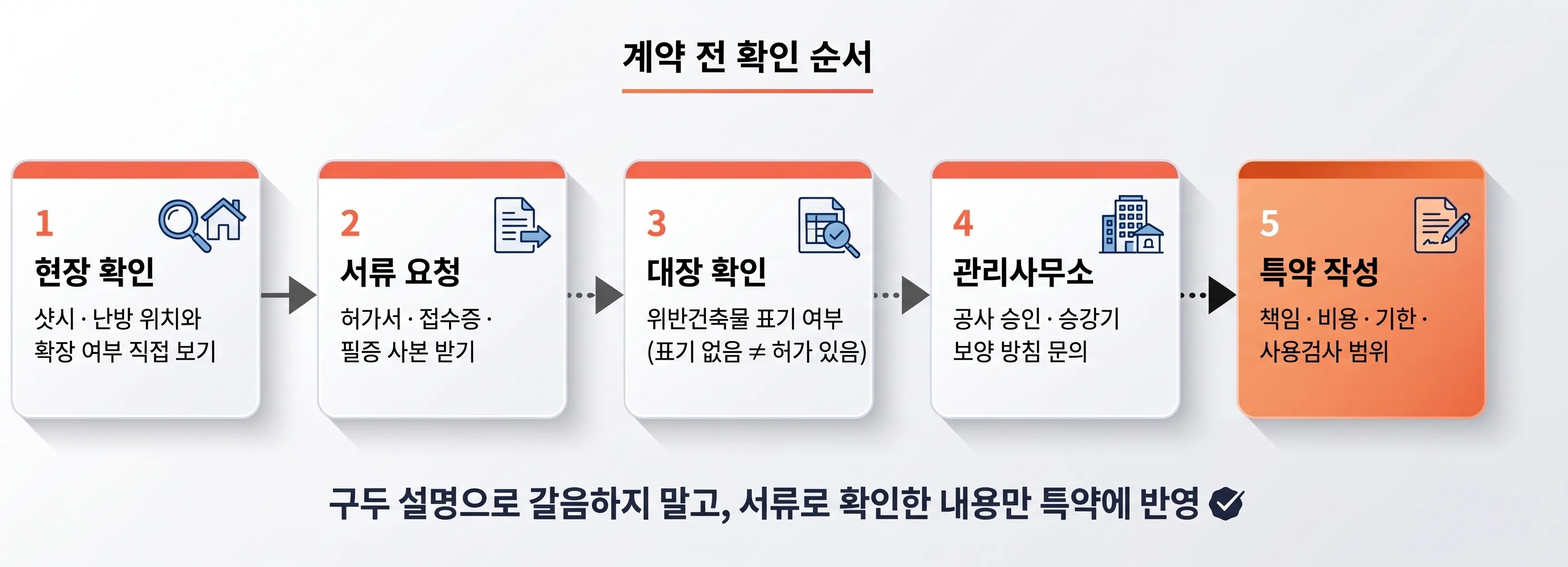
Work through these four and you will know where the unit stands before you sign.
| Step | How |
|---|---|
| See it yourself | Check whether the balcony run has windows and heating, and whether it opens into the living room or bedroom as one space. For whether a unit is extended, the site is more reliable than the register. |
| Ask for documents | Ask the seller for copies of the permit, the filing receipt, or the completion certificate. If there are none, proceed on the basis that there is no permit. |
| Check the register | Look for an unauthorised-structure flag on Gov24 or Seumteo. The absence of a flag does not mean a permit exists. |
| Ask the management office | Ask in advance whether the complex requires the permit document for interior work, and how elevator protection is handled. |
Responding to What You Find
| Condition | What it means | What to do |
|---|---|---|
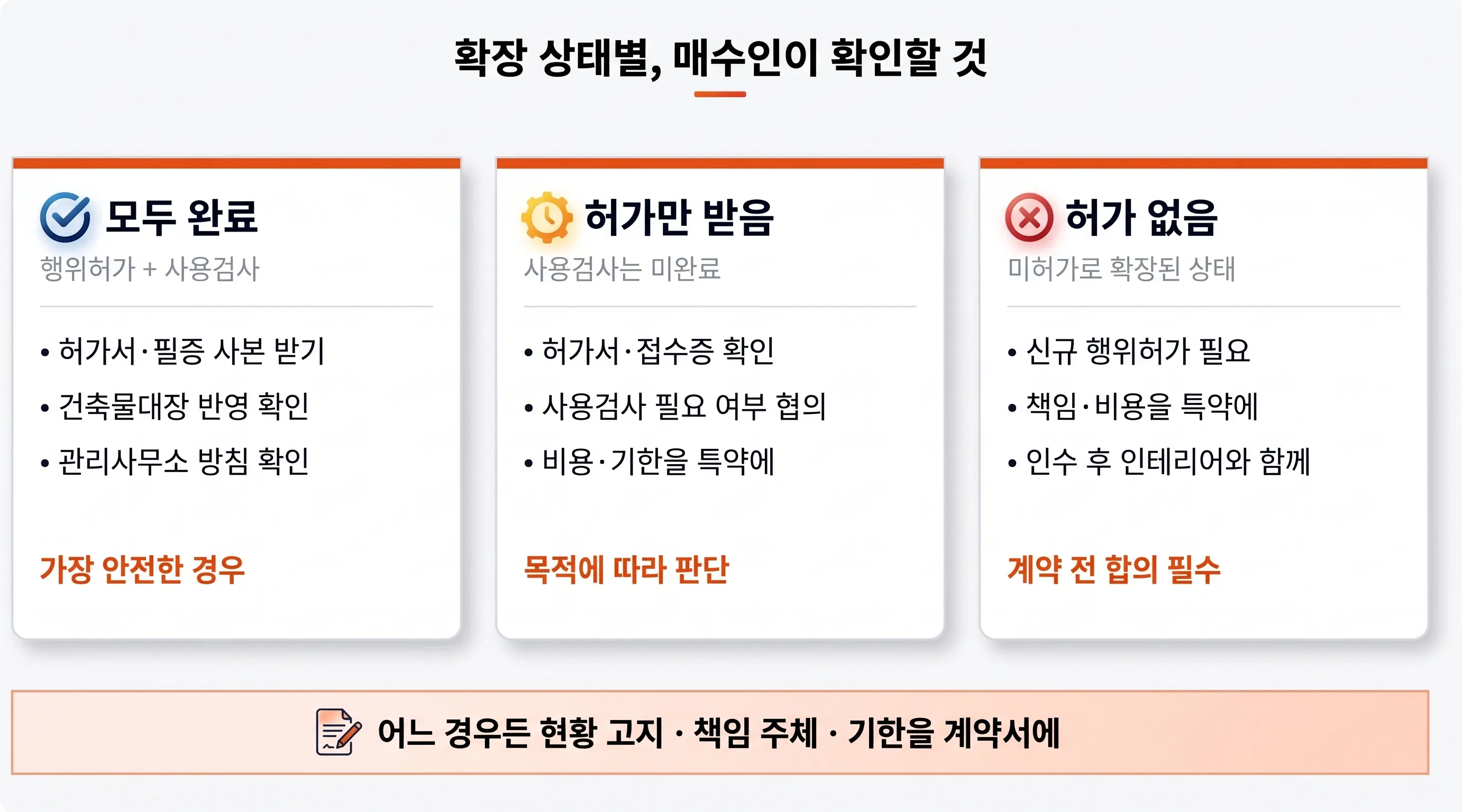
| ① Permit and inspection both done | The procedure is complete. | Take copies of the permit and the certificate, and confirm it is reflected on the register. This is the safest case. |
| ② Action permit only | The plan was approved; the completion inspection was never done. | Decide whether you need the inspection by asking what the unit is for — living in it, reselling, or a loan condition. If you do, put the cost split into a special clause. |
| ③ No permit | The balcony was extended without one. | Either have the seller obtain the permit before closing, or take it on yourself alongside your interior work and have it reflected in the price. |
If You Take It On Yourself
Taking on an unpermitted unit and regularising it usually runs in this order: as-built drawings, resident consent, filing with the district office, then the work. In most cases this is not a retroactive approval of the old extension but the same procedure as a fresh one.
Resident consent is a separate requirement (half or more is the benchmark, though this varies by complex and by jurisdiction), and once the documents are in order it typically takes two weeks to a month. If you are replacing windows or insulation before moving in, running it alongside that work is usually better on both schedule and cost.
Going all the way to the completion inspection calls for performance documents and a site check for fire-rated panels, glass and doors, which widens the scope of work. The total against simply restoring the balcony depends on the condition of the unit, so look at it on site with your contractor before deciding.
Clauses to Insist On
From the buyer's side, spelling out these four is the safe course. Adapt the wording to the case, and have a legal professional review it where that matters.
④ matters most. Leave the inspection question blank and it returns as "I only promised the permit" against "you agreed to sort it out completely."
Before You Sign
- Did you confirm the extension on site yourself?
- Do you hold copies of the permit, receipt or certificate — not just a verbal account?
- Have you settled why you would need the completion inspection (living in it, reselling, a loan)?
- Are the responsible party, the cost, the deadline and the inspection question all in the special clauses?
Frequently Asked Questions
Q. Is there a problem with buying an apartment whose balcony was extended?
The purchase itself is not prohibited, but responsibility for regularising the extension can pass to you. Confirm the permit and inspection status before signing, and fix the responsible party, the cost and the deadline in a special clause.
Q. Is an action permit alone enough from a buyer's point of view?
The action permit approves the planned work; the procedure ends with the completion inspection, and in our experience only the inspection puts it on the register. How far you need to go depends on whether you will live in it, resell, or carry a loan condition — settle that before you sign.
Q. Can I make the seller pay for it?
No statute decides this; it is for the parties to agree. Either have the seller obtain the permit before closing, or take it on yourself with the cost reflected in the price — then write whichever you chose into a special clause.
Q. How long does it take if I file after taking it on?
Once the documents are in order, typically two weeks to a month. Resident consent is a separate requirement, and the consent ratio varies by complex and by jurisdiction. Send us the building and unit number with the current condition before you sign and we will tell you how it would run. Request a pre-review →
Sources: Multi-Family Housing Management Act Article 35 and Table 3 of its Enforcement Decree; the December 2005 legalisation of balcony structural alteration; the Housing Act Enforcement Decree amendment notice easing consent requirements for balcony expansion (Ministry of Land, Transport and Maritime Affairs); Michuhol-gu Office, "Building Administration Explained" (balcony expansion in multi-family housing: action permit and completion inspection). This article is general information, not legal advice, and practice varies between district offices and between complexes. Confirm the specifics with the district office with jurisdiction and with a professional.