
Regulation Guide · 2026. 10
Balcony Expansion Permit —
What Agents Should Check and Disclose
LEA Architects · Junsu Kim, Architect
In Short
- Most of these disputes come down to one thing the contract never says: who is to clear up an unpermitted expansion.
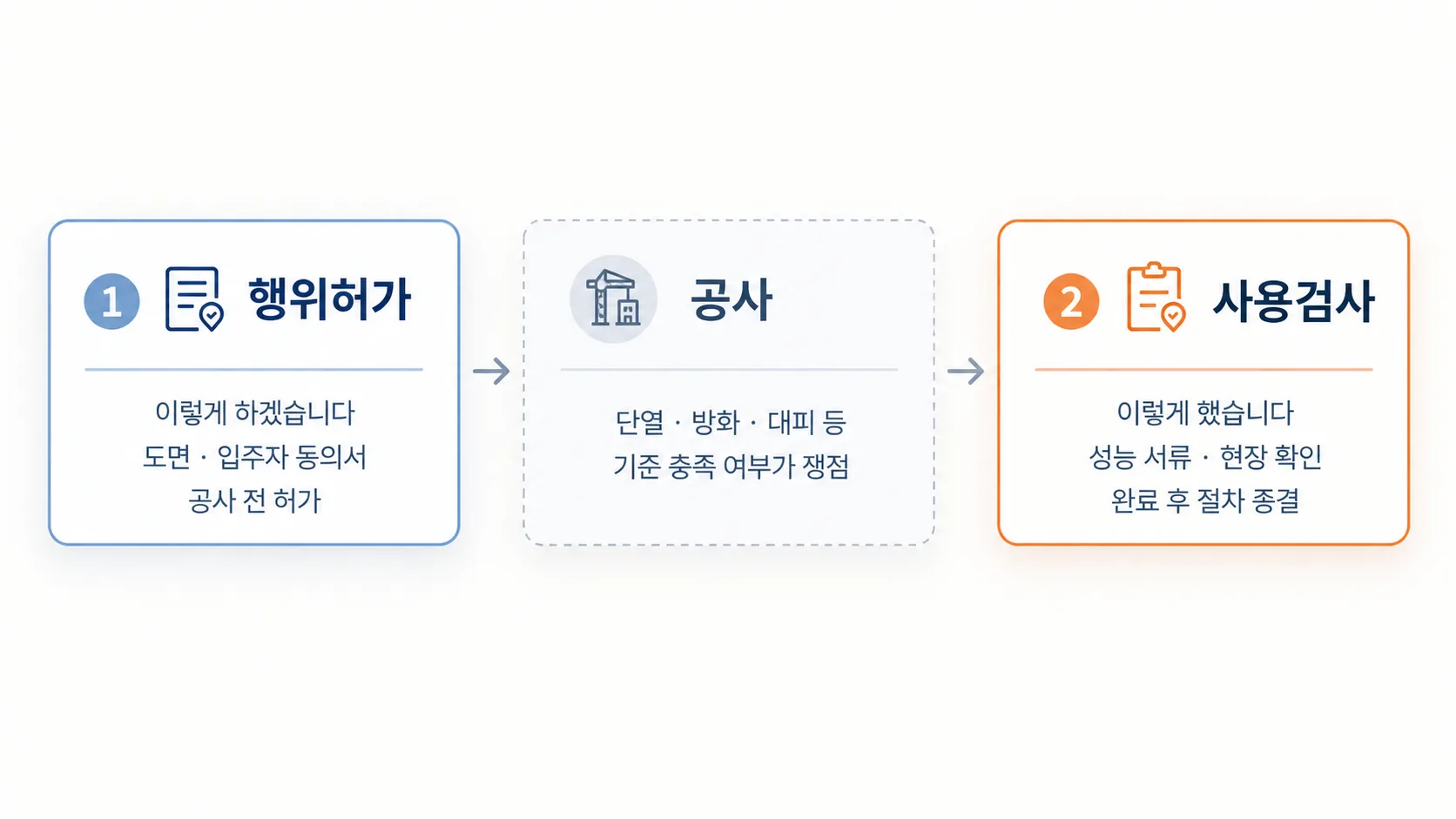
- There are two stages — the action permit ("we will") and the completion inspection ("we did"). In practice, work stops at the first.
- Writing the responsible party, the cost and the deadline into a special clause takes most of the weight off the agent.
Why It Surfaces Mid-Transaction
Apartments with the balcony opened up into the living room or a bedroom are common in Korea. The trouble is that whether the expansion ever went through an action permit (haengwi heoga) stays invisible day to day, and then becomes an issue the moment the unit is sold.
Buyers now look this up themselves, or ask an AI, before signing. Interior contractors ask for the permit when they quote the work. And a growing number of complexes require the permit document before the management office will approve elevator use for a move-in renovation.
The pattern we see runs like this. The seller lists a unit that was already expanded, the buyer learns there is no permit and grows uneasy, and that unease turns into a demand for a price adjustment or a split of the cost. In a moving market it also gets used as grounds to walk away. What began as a matter between two parties ends up on the agent's desk as a question of disclosure.

Two Stages: Permit and Inspection
Expanding a balcony in multi-family housing requires an action permit under the Multi-Family Housing Management Act (Article 35; Enforcement Decree, Table 3). Balcony structural alteration was legalised in December 2005, but what that allowed was the expansion itself — not expanding without a permit.
The procedure splits into two stages, mirroring the way a building permit is paired with an occupancy approval.
Three Common Misconceptions
| The assumption | What actually holds |
|---|---|
| "Isn't filing a report enough?" | The rule is an action permit followed by a completion inspection. In the field, though, most owners take the permit and never return for the inspection. |
| "With the permit, it must be on the building register." | In practice the permit alone does not reach the register; it stays as a record in the district office system. Only the completion inspection puts it on the register. Practice varies by office, so confirm with the one with jurisdiction. |
| "We have the permit, so the dispute is settled." | The permit covers the planned work, while what the buyer usually wants is a fully lawful unit. Raise the inspection question explicitly so both sides are measuring the same thing. |
Options During the Sale
No statute says who must do what here. It is for the parties to agree, which leaves the agent proposing whichever of these fits the situation.
| Route | Fits when | Watch for |
|---|---|---|
| A. Seller obtains the permit before closing | The buyer wants it cleared before moving in and the seller is willing | Collecting resident consent falls to the seller. Set a deadline so the schedule does not run past the balance payment date. |
| B. Buyer takes it on and files a new permit | The buyer is planning substantial interior work, windows and insulation included | This usually runs as a fresh expansion rather than a retroactive fix of the old one. Fold the cost into the price negotiation. |
| C. Completion inspection is demanded too | The buyer wants the unit fully regularised | Fire doors, insulation and escape space have to meet standard, so scope and cost grow. Weigh the total against simply restoring the balcony — a call to make after a site visit. |
Note that an action permit application also needs resident consent (half or more is the benchmark, though this varies by complex and by jurisdiction), and once the documents are in order it typically takes two weeks to a month. Often the buyer's interior contractor is the one who goes and collects the consent forms.
Clauses Worth Writing In
For an already-expanded unit, we suggest setting out these four points specifically in the contract's special clauses. Adapt the wording to the case, and have a legal professional review it where that matters.
④ matters most. Leave out whether the inspection is included, and the argument comes back later as "you agreed to sort it out completely" against "I promised the permit, nothing more."
Don't Let the Disclosure Statement Slip
Under Article 25 of the Licensed Real Estate Agents Act, an agent must verify and explain matters such as whether the building register flags the property as an illegal building; Article 30 of the same Act can make the agent liable for loss caused intentionally or negligently. Reported cases include one where the register showed an illegal building while the disclosure statement was ticked as lawful, and liability followed.
Balcony expansion deserves extra care precisely because it often does not show on the register. Rather than recording "no issue" on the strength of a clean register alone, if a site visit told you the balcony is expanded, put that and the permit status into the statement or the special clauses.
Agent's Checklist
| Stage | What to check |
|---|---|
| Taking the listing | Whether the balcony is expanded, on site; whether the building register carries an illegal building flag |
| Before contract | Ask the seller for any permit history (permit document or filing receipt), and whether the completion inspection was done |
| Drafting | Condition, responsible party, cost, deadline, and whether the inspection is included — all in the special clauses |
| Before closing | Agreement on what happens if the schedule slips (extension, settlement, and so on) |
What an Architect Can and Cannot Take On
An architecture office handles the as-built drawings, prepares and files the action permit application, and runs the completion inspection where it is needed. The price and responsibility argument between seller and buyer, on the other hand, is for the parties to settle. Work moves far faster when you come to us with the dispute already resolved and the scope clearly stated.
Frequently Asked Questions
Q. Does an action permit alone make a balcony expansion lawful?
The action permit approves the plan, and the procedure only ends once the completion inspection is passed after the work is done. Many owners stop at the permit stage, but that leaves the procedure unfinished.
Q. Does an action permit show up on the building register?
In our experience the permit alone does not reach the register; it stays as a record in the district office system. Only the completion inspection puts it on the register. Practice varies between offices, so confirm with the one with jurisdiction.
Q. Who is responsible for resolving the issue during a sale?
No statute assigns it; the parties agree. The seller may handle it before closing, or the buyer may take it on with their interior work. Either way, the responsible party, the cost and the deadline belong in a special clause.
Q. Can this be done within our transaction schedule?
Send us the building and unit number along with the current condition, and we will come back with a route and a timeline. Commercial use changes and register amendments that a transaction needs can be looked at at the same time. Request a pre-review →
Sources: Multi-Family Housing Management Act Article 35 and Table 3 of its Enforcement Decree; Licensed Real Estate Agents Act Articles 25 and 30; the December 2005 legalisation of balcony structural alteration; the Housing Act Enforcement Decree amendment notice easing consent requirements for balcony expansion (Ministry of Land, Transport and Maritime Affairs); Michuhol-gu Office, "Building Administration Explained" (balcony expansion in multi-family housing: action permit and completion inspection); Legal Times reporting on rulings concerning illegal building flags and the property disclosure statement. This article is general information, not legal advice, and practice varies between district offices and between complexes. Confirm the specifics with the district office with jurisdiction and with a professional.